How Much Does a Modular Home Cost in California? (2026 Price Guide)
The modular home cost California buyers should plan for usually lands between $250 and $400+ per square foot once the home is set, connected and ready to live in. The factory-built home itself is only part of that. Land, site work, utilities and fees make up the rest. You can compare sizes and layouts across our California modular home models before you price a lot.
Key Takeaways
- Plan on $250 to $400+ per square foot for a finished modular home in California, not counting land.
- The factory price is not the full price. Foundation, delivery, crane, utilities and permits often add 30 to 50 percent.
- Modular is not manufactured. A California modular home is built to the same state building code as a site-built house.
- Speed saves money. A shorter build means fewer months of loan interest and rent.
- Your lot decides the final number. Slope, access and utility distance swing costs more than floor plan choice.
What Does a Modular Home Cost Per Square Foot in California?
Most California buyers see two prices. The first is the factory price. The second is the all-in, move-in price. The gap between them is where budgets break.
The factory price covers the modules built indoors. That usually means framing, walls, roof, windows, plumbing and wiring runs, and many interior finishes. In today’s market, that package often runs $150 to $250 per square foot.
The all-in price adds everything that happens on your land. That includes the foundation, the crane set, utility hookups, permits and the finish work that joins the modules. For a finished home, $250 to $400+ per square foot is a realistic planning range. Coastal cities and hillside lots push toward the top.
For context, the U.S. Census Bureau reports that contractor-built homes started in the West in 2025 had an average contract price of $213.85 per square foot, not counting the lot. That figure comes from the Census new housing characteristics tables. California runs well above the West average because of labor, energy code and fire rules.
Why the ranges are so wide
Two identical floor plans can cost very different amounts. A flat, cleared lot next to a paved street is cheap to build on. A sloped lot at the end of a narrow road may need retaining walls, a longer driveway and a bigger crane. Finish level matters too. Quartz, custom cabinets and large sliding doors add up fast.
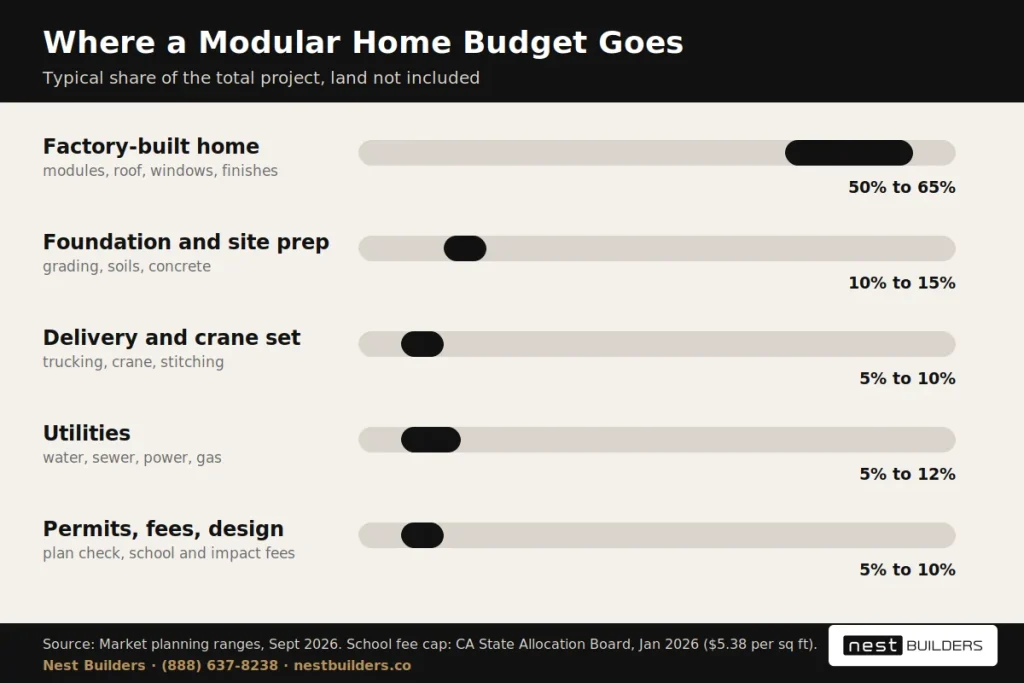
| Cost layer | What it covers | Typical share of total |
|---|---|---|
| Factory-built home | Modules, framing, roof, windows, core finishes | 50% to 65% |
| Foundation and site prep | Grading, soils work, concrete foundation | 10% to 15% |
| Delivery and crane set | Trucking, crane, setting and stitching modules | 5% to 10% |
| Utilities | Water, sewer or septic, power, gas, trenching | 5% to 12% |
| Permits, fees and design | Plan check, school fees, impact fees, engineering | 5% to 10% |
| Exterior finish work | Porches, decks, driveway, landscaping | 3% to 8% |
What Is Included in a Modular Home Price?
Ask every builder for a written list of what their price includes. “Base price” means different things to different companies. Here is what to check line by line.
Usually included in the factory price
- Structure: floor system, walls, roof framing and sheathing.
- Envelope: windows, exterior doors, insulation and siding.
- Rough systems: plumbing, electrical and HVAC runs inside each module.
- Interior finishes: drywall, flooring, cabinets, counters and fixtures at the standard level.
Often not included
- Land and any survey or soils report.
- Foundation and grading.
- Transport and crane costs.
- Utility connections from the street to the home.
- Permits and impact fees charged by your city or county.
- Garage, decks, driveway and landscaping.
- Solar panels, which California requires on most new single-family homes.
Every factory-built home sold in California must meet state building standards and carry a state insignia. The HCD Factory-Built Housing program oversees that process. Ask your builder to confirm the insignia is part of their price.
Modular Home Cost by Size in California
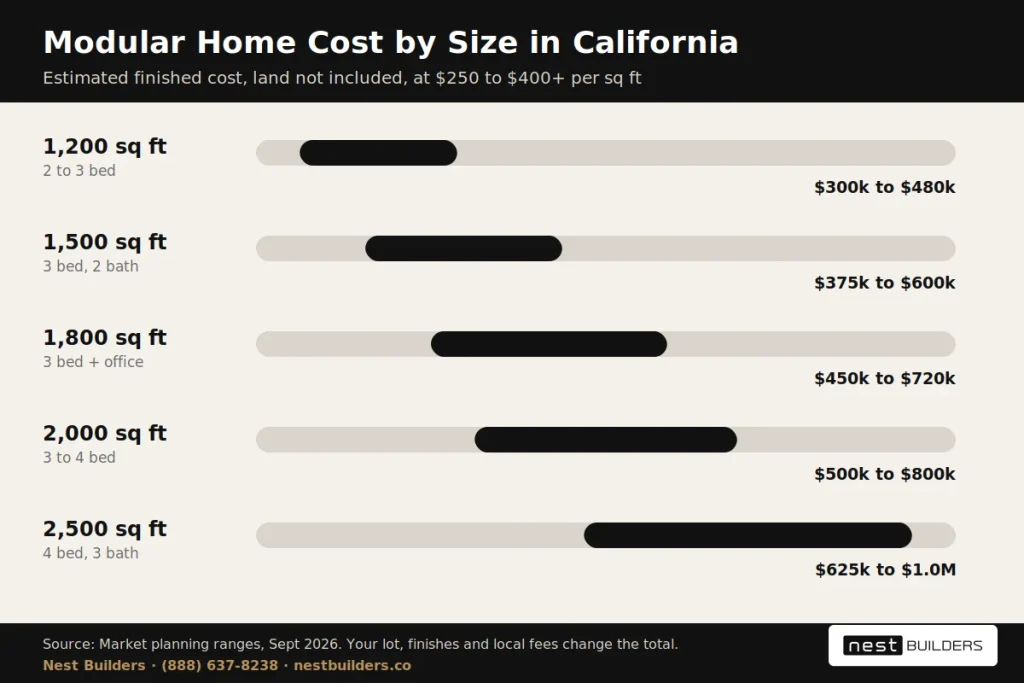
Size is the easiest way to set a first budget. The table below uses the $250 to $400 per square foot range for a finished home. It does not include land.
| Home size | Example layout | Estimated finished cost (no land) |
|---|---|---|
| 1,200 sq ft | 2 to 3 bedrooms, 2 baths | $300,000 to $480,000+ |
| 1,500 sq ft | 3 bedrooms, 2 baths | $375,000 to $600,000+ |
| 1,800 sq ft | 3 bedrooms, 2.5 baths, office | $450,000 to $720,000+ |
| 2,000 sq ft | 3 to 4 bedrooms, 2.5 baths | $500,000 to $800,000+ |
| 2,500 sq ft | 4 bedrooms, 3 baths | $625,000 to $1,000,000+ |
A home like the Coastal floor plan is 1,274 square feet with 3 bedrooms and 2 baths. That puts it near the top row of this table. A larger plan like our 2,185 square foot Paso Robles sits between the 2,000 and 2,500 rows.
Hidden Costs Most Buyers Miss
The factory quote is easy to compare. The site costs are where surprises hide. Watch for these signs that your lot will cost more than average.
Signs your site costs will run high
- Slope: anything steeper than a gentle grade may need engineered foundations or retaining walls.
- Tight access: narrow roads, overhead lines or trees can block a truck or crane.
- No sewer line: a septic system adds design, testing and install costs.
- Long utility runs: power or water far from the build spot means more trenching.
- Fire hazard zone: high-risk areas require ember-resistant vents, siding and roofing.
- Poor soil: expansive clay or fill soil may need a deeper foundation.
School and impact fees
Many buyers forget school fees. In January 2026, the State Allocation Board raised the maximum Level I residential school fee to $5.38 per square foot. The details are in the state school fee adjustment. On a 2,000 square foot home, that alone can reach $10,760. Cities and counties may add park, traffic and utility capacity fees on top.
Energy code and solar
California’s energy code requires solar on most new single-family homes. The 2025 standards took effect on January 1, 2026. Your builder should size the system as part of the design, not as an extra at the end.
How Regional Prices Differ Across California
The same home costs more in some regions. Labor rates, permit timelines and land prices drive the gap. Nest Builders works across the Bay Area, Sacramento, Los Angeles and San Diego, and each has its own pattern.
| Region | Relative build cost | What drives it |
|---|---|---|
| Bay Area | Highest | Labor rates, hillside lots, long plan check times |
| Los Angeles | High | Fire rebuild demand, hillside access, city fees |
| San Diego | High | Coastal rules, land prices, fire hazard zones |
| Sacramento | Moderate | Flatter lots, easier access, lower labor rates |
Want a real number for your lot, not a range? Call Nest Builders at (888) 637-8238 and ask for a site-specific estimate. Have your address and any survey ready, and we can flag slope, access and utility costs early.
Modular vs Manufactured Home Prices in California
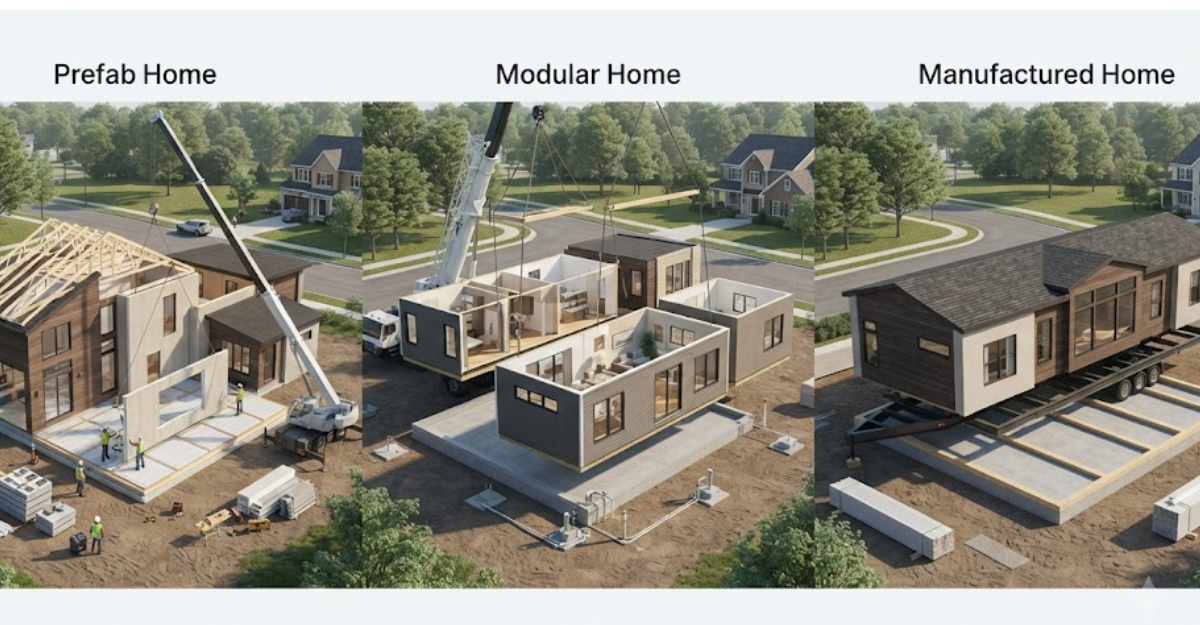
Price searches often mix modular and manufactured homes. They are not the same product, and the price gap is large for a reason.
A manufactured home is built to a federal HUD code on a steel chassis. A California modular home is built to the state building code and set on a permanent foundation, just like a site-built house. The U.S. Census Bureau reports the average new manufactured home in California sold for $164,800 in 2025. That figure is from the Census manufactured housing survey, and it does not include land or site work.
| Feature | Modular home | Manufactured home |
|---|---|---|
| Building code | California Building Standards Code | Federal HUD code |
| Foundation | Permanent concrete foundation | Steel chassis, piers or foundation |
| Typical financing | Construction loan, then standard mortgage | Often a chattel or specialty loan |
| Design flexibility | Multi-story, custom layouts possible | Mostly single-story, set widths |
| Price level | Close to site-built | Lowest upfront cost |
If you are comparing listings, check which code the home is built to. A low price on a manufactured home is not a fair comparison to a finished modular house.
How Long a Modular Build Takes and What Time Costs You
Time is a real cost. Every month your project runs, you may pay rent, loan interest and storage. That is why schedule belongs in your budget, not only in your calendar.
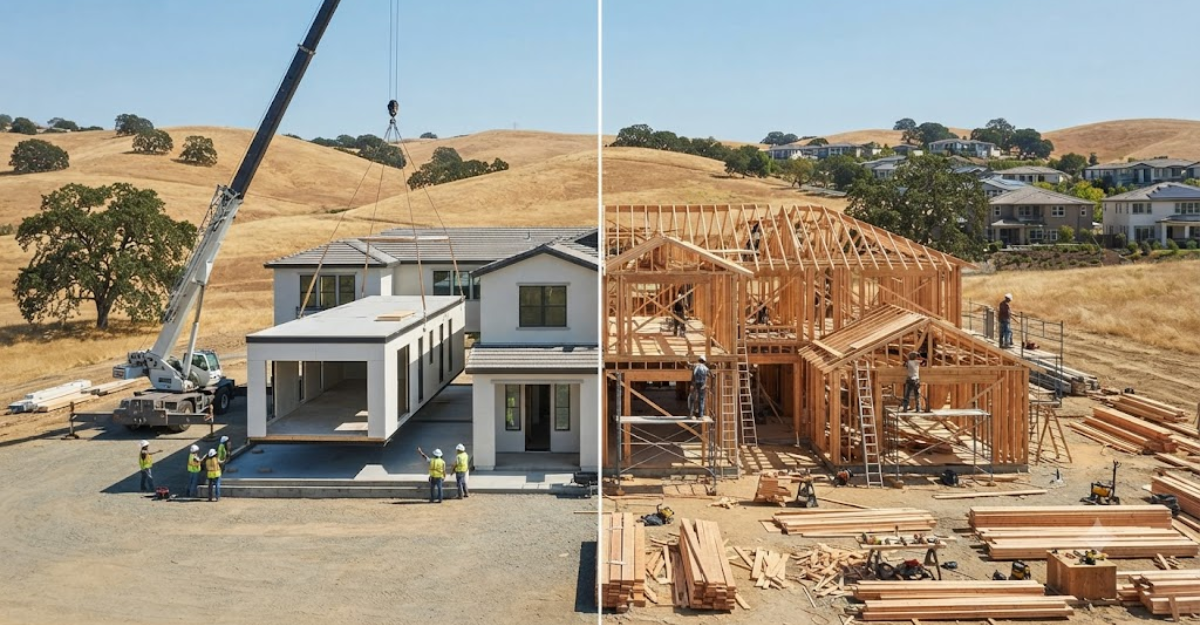
Our modular models run on a 10 to 12 month timeline from start to move-in. Custom site-built homes typically run 12 to 14 months. Most of the modular schedule is design, permits and site prep. The factory build and crane set are the fast part.
Typical modular project phases
- Feasibility and lot review: zoning, access, utilities and a first budget.
- Design and plan choice: pick a model, adjust the layout and choose finishes.
- Permits and plan check: local building department review, which varies most by city.
- Site prep and foundation: grading, trenching and concrete, while the factory builds.
- Delivery and set: modules arrive and a crane sets them, often in a day or two.
- Finish and final inspection: stitching, utility hookups, decks and sign-off.
Carrying costs to add to your budget
- Construction loan interest for each month of the build.
- Rent or a mortgage on your current home while you wait.
- Property tax and insurance on the land during construction.
- A contingency fund of 10 to 15 percent for site surprises.
Paying for a Modular Home in California
Most buyers do not pay cash. The usual path is a construction loan that pays the builder in stages, then converts to a standard mortgage once the home is finished.
Because a modular home sits on a permanent foundation and meets the state code, lenders and appraisers generally treat it like a site-built home. Ask your lender these questions early:
- Draw schedule: does the loan pay a deposit to the factory before the home ships?
- One-time close: can the construction loan convert to a mortgage without a second closing?
- Appraisal: will the appraiser use recent sales of new homes nearby?
- Land equity: if you own the lot, can its value count toward your down payment?
Modular vs Site-Built: Where the Savings Come From
Modular homes do not always cost less per square foot than site-built homes. The savings often come from time, waste and fewer surprises. If you want the full side-by-side, read our guide on modular versus stick-built homes.
Here is where the money is saved:
- Shorter schedule: the factory builds while your site is prepared, so work happens at the same time.
- Less weather damage: framing stays dry indoors.
- Lower loan interest: fewer months on a construction loan means less interest paid.
- Fixed factory pricing: the home price is locked earlier than on most site builds.
If you are weighing a fully custom design instead, compare the numbers in our breakdown of custom home building costs. Nest Builders custom homes start from $400 per square foot for our Traditional style.
How to Lower Your Modular Home Cost
- Pick the lot with the builder. Have your builder walk the land before you buy. Access and slope are cheaper to avoid than to fix.
- Start from an existing model. A proven plan skips much of the design and engineering fee.
- Keep the footprint simple. Rectangles and fewer roof lines cost less to build and set.
- Choose finishes early. Changes after the factory order are the most expensive changes.
- Get utilities quoted first. Ask the utility company for connection costs before you commit.
- Line up financing early. A pre-approved construction loan avoids delays that cost money.
Modular Home Cost California FAQs
Is it cheaper to build a house or get a modular?
A modular home is often cheaper overall because the build takes less time, which cuts loan interest and rent. The price per square foot can be close to site-built. Your lot, finishes and local fees decide which option wins for your project.
Can you get a modular home for $100,000?
Not a finished, full-size modular home in California. That budget may cover a small factory-built unit or a manufactured home on its own. The average new manufactured home in California sold for $164,800 in 2025, before land and site work.
How much does a 2,000 square foot modular home cost?
A finished 2,000 square foot modular home in California usually costs about $500,000 to $800,000 or more, not counting land. Hillside lots, long utility runs and premium finishes push the price higher. Flat lots with easy access land at the lower end.
Is $200,000 enough to build a house in California?
For most people, no. $200,000 rarely covers a finished single-family home in California once foundation, utilities and fees are added. It may work for a small backyard unit on a lot you already own, with simple site conditions.
Is it cheaper to build or buy a home in 2026?
It depends on your area. Buying is often faster, but you pay for an older home’s upkeep. Building costs more upfront but gives you a new, energy-efficient home. Compare local home prices with a full build budget, including land, before deciding.
Get a Real Modular Home Price for Your California Lot
Ranges help you plan. A lot-specific estimate helps you decide. Call Nest Builders at (888) 637-8238 and tell us your address, the size you need and your target move-in date. We will walk you through factory price, site work and fees in one estimate.