Best Modular Home Builders in California: How to Choose (Checklist)
The best modular home builders in California hold an active CSLB license, work with state-approved factory-built homes, handle site work and permits, and put price, timeline and warranty in writing. A great floor plan means little if the builder cannot get it permitted and set on your lot. See the modular homes we build as you work through this checklist.
Key Takeaways
- Check the license first. Look up every builder on the CSLB website before you share your plans.
- Factory and site work must connect. The best builders manage both, or clearly name who does each part.
- Get the full scope in writing. Foundation, crane, utilities, permits and fees should be listed, not assumed.
- Visit a finished home. Photos show design. A walk-through shows build quality.
- Compare quotes line by line. The lowest base price often leaves out the most.
What Makes a Modular Home Builder the “Best”?
Rankings and top 10 lists tell you who is popular. They do not tell you who can build on your lot. A builder that is perfect for a flat lot in Sacramento may be a poor fit for a hillside lot in Marin.
In California, a modular home project has two halves. The first is the factory, which builds the home to state standards. The second is the site, which covers the lot, foundation, utilities, permits and the crane set. Most problems happen where those halves meet.
So the best builder is the one who owns that handoff. Look for these four traits:
- Licensed and insured for general building work in California.
- Experienced with factory-built homes that carry the state insignia.
- Able to handle permits and site work, or manage the people who do.
- Transparent on price, schedule and warranty from the first meeting.
The 15-Point Checklist for Choosing a Modular Home Builder
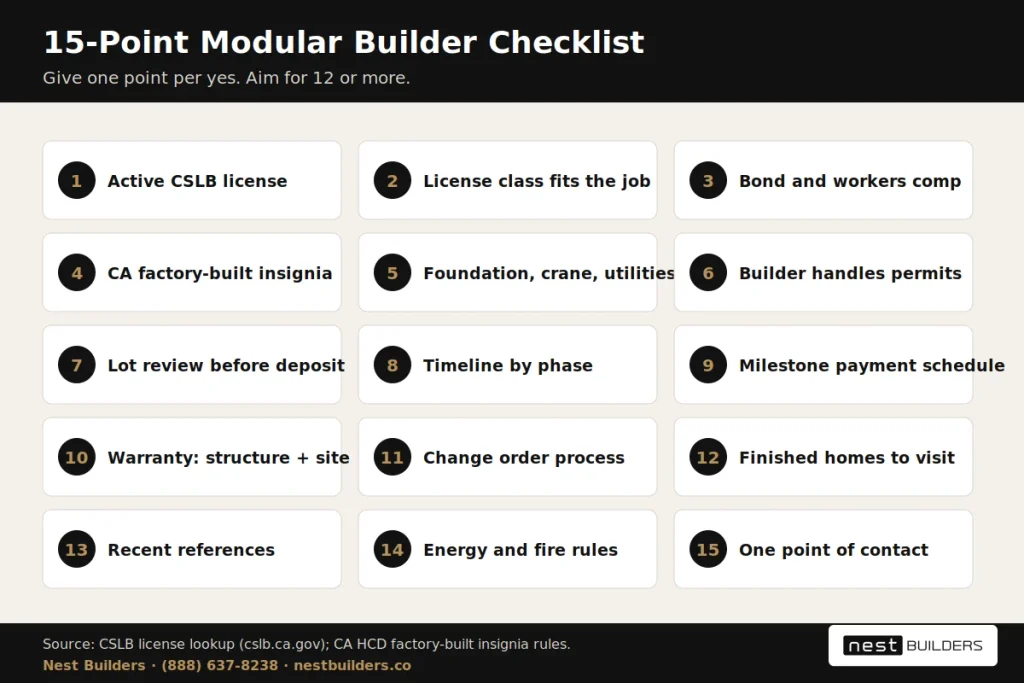
Use this table as a scorecard. Give each builder one point for every “yes.” A strong builder should score 12 or higher.
| # | Checklist item | How to verify |
|---|---|---|
| 1 | Active California contractor license | CSLB online license lookup |
| 2 | License class fits new home building | Classification shown on the CSLB record |
| 3 | Bond and workers’ comp on file | Listed on the CSLB record |
| 4 | Homes carry the California factory-built insignia | Ask to see insignia and plan approval |
| 5 | Written scope covers foundation, crane and utilities | Line items in the proposal |
| 6 | Builder handles permits and plan check | Named in the contract |
| 7 | Lot review before design or deposit | Site visit or feasibility report |
| 8 | Timeline in writing, by phase | Schedule attached to the contract |
| 9 | Clear payment schedule tied to milestones | Draw schedule in the contract |
| 10 | Written warranty for structure and site work | Warranty document |
| 11 | Change order process explained | Contract clause with pricing rules |
| 12 | Finished homes you can visit | Walk-through or project list |
| 13 | References from recent buyers | Phone numbers you can call |
| 14 | Plans that meet California energy and fire rules | Energy report and fire zone review |
| 15 | One point of contact for the whole project | Named project manager |
Licenses and Approvals to Verify
CSLB contractor license
Anyone doing construction work worth $1,000 or more in California, including labor and materials, generally needs a license from the Contractors State License Board. That threshold rose from $500 on January 1, 2025. Use the CSLB license lookup tool to confirm the license is active, see its classification, and check bond and workers’ comp status.
Factory-built housing approval
California requires every factory-built home sold to a first buyer to carry a state insignia. The insignia is only issued for homes with approved plans, through a state-approved quality assurance agency. The rules are on the HCD insignia requirements page. Ask the builder to show how their homes meet it.
Dealer or builder role
Some companies only sell factory homes. Others design, permit and build the whole project. Ask directly which role the company plays. If they only sell the home, you will need a separate licensed contractor for the site, and you will manage the gap between them.
Questions to Ask Every Modular Builder
- What does your price include, line by line? Ask for foundation, delivery, crane, utilities, permits and fees as separate items.
- Who does the site work? Your crew, a subcontractor, or me?
- Will you visit my lot before I pay a deposit?
- How long is each phase? Design, permits, factory build, site work and set.
- When is the factory deposit due, and how is it protected?
- What does the warranty cover, and who do I call after move-in?
- Can I visit a finished home and talk to the owner?
- How do you handle fire zone and energy code requirements?
- How are change orders priced once the factory order is placed?
- Who is my single point of contact from start to finish?
Want to hear how we answer these? Call Nest Builders at (888) 637-8238 and ask us any question on this list. We design, permit and build under one contract, so you get one answer for the factory and the site.
Red Flags When Choosing a Modular Builder
- No license number on the website, proposal or truck.
- A large upfront payment before any design, permit or factory milestone.
- A “base price” with no list of what it leaves out.
- No lot visit before the quote.
- Pressure to sign fast to “lock in” a price.
- No finished homes or references you can contact.
- Vague warranty terms or a warranty that only covers the factory.
- Unclear responsibility for permits and inspections.
For home improvement contracts, the CSLB says a down payment cannot be more than $1,000 or 10 percent of the contract price, whichever is less. That guidance is on the CSLB contract rules page. New home and factory contracts can follow different payment rules, so ask how any deposit is held and when it is released.
How to Compare Modular Home Quotes
Two quotes can look $100,000 apart and still cost the same in the end. The difference is usually what each one leaves out.
| Line item | Builder A | Builder B | What to ask |
|---|---|---|---|
| Factory-built home | Included | Included | Which finish level? |
| Foundation | Included | Not included | What type and size? |
| Delivery and crane | Included | Allowance only | What if access is tight? |
| Utility connections | Allowance | Not included | Distance to street covered? |
| Permits and fees | Included | Not included | Are school and impact fees in? |
| Solar | Included | Optional | Sized to energy code? |
| Decks, porch, driveway | Not included | Not included | Budget separately |
Use a sheet like this for every quote. Fill in “not included” items with your own estimate so every builder is compared on the same full project. Our custom build cost breakdown shows the soft costs and fees to add.
Match the Builder to Your Project Type
The right builder depends on what you are building. Not every modular company builds full-size family homes.
- Backyard unit: look for a builder with small-unit plans and fast permitting in your city.
- Primary family home: look for 3 and 4 bedroom plans, two-story options and garage choices.
- Fire rebuild: look for fire zone experience and a clear plan for utility restoration.
- Custom look on a modular budget: look for a design-build team that offers both modular and site-built homes.
Plans range widely. The Nest Duo XL plan offers 2 to 3 bedrooms in 1,150 square feet, while the Ridgeline 1564 plan gives a family 3 bedrooms in 1,564 square feet. A good builder helps you pick the size that fits both your lot and your budget.
Know What You Are Buying First
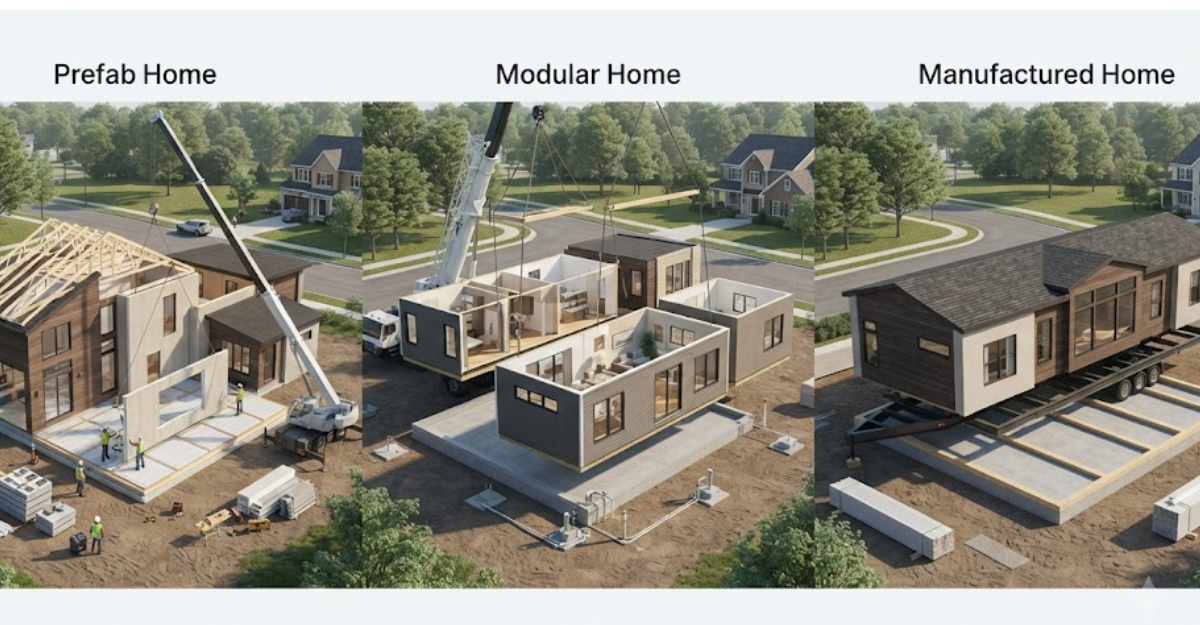
Before you compare builders, make sure every company is quoting the same type of home. A manufactured home and a modular home are built to different codes and financed differently. If the terms are new to you, read our guide to prefab versus manufactured homes.
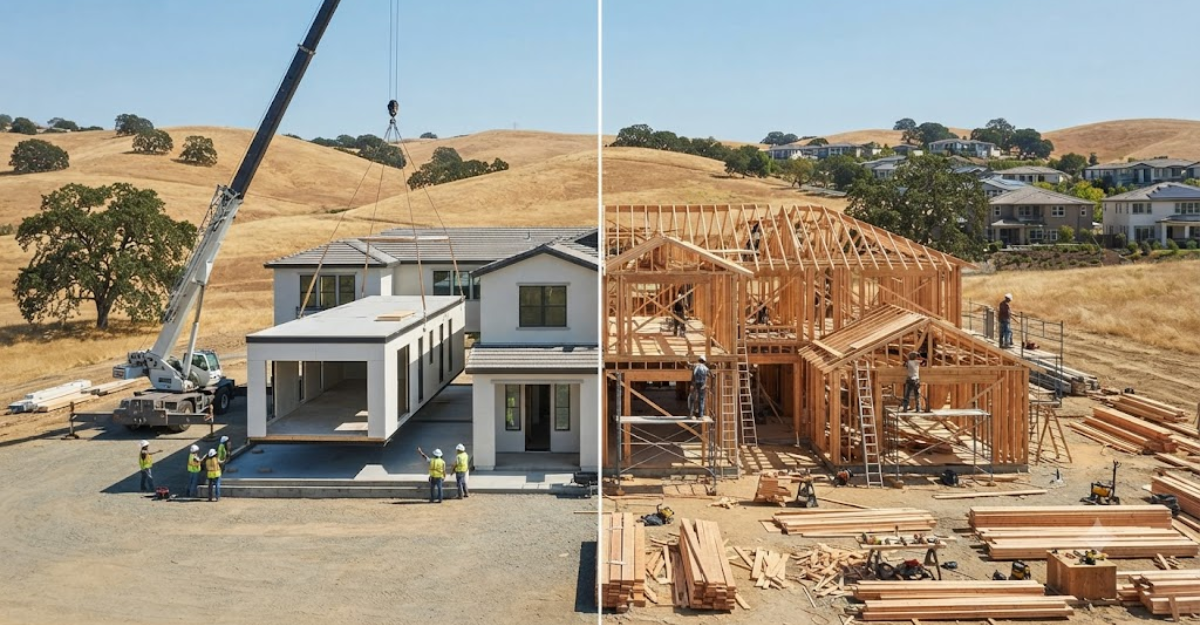
Also check the schedule claims. The Modular Building Institute says modular construction can cut a project schedule by 30 to 50 percent because factory and site work overlap. You can read how on the MBI construction timelines page. In California, permit time still depends on your city, so ask every builder for a schedule by phase.
How to Shortlist Modular Builders in One Week
- Day 1, list five builders that serve your county and build the home type you want.
- Day 2, run the license check for each one and drop any with an inactive license or missing workers’ comp.
- Day 3, send the same short brief to the rest: lot address, home size, bedrooms, budget and move-in goal.
- Day 4, book lot visits or video calls with the builders who reply with real questions about your land.
- Day 5, ask for a sample contract, warranty and schedule by phase.
- Day 6, call two references for each builder and ask what went wrong and how it was fixed.
- Day 7, score each builder on the 15-point checklist and keep the top two for full quotes.
What Happens After You Choose a Builder
Knowing the next steps helps you judge whether a builder is organized. A strong builder can explain this path in plain words at the first meeting.
- Feasibility: zoning, setbacks, fire zone, utilities and a first budget for your lot.
- Design agreement: plan selection, layout changes and finish choices.
- Permit package: site plan, foundation design, energy report and state plan approval for the home.
- Factory order: the home is scheduled for production once permits are in sight.
- Site work: grading, utilities and foundation while the factory builds.
- Set and finish: crane day, joining the modules, hookups, inspections and a final walk-through.
If a builder cannot tell you who handles each step, treat that as a warning sign. Gaps between the factory and the site are where delays and extra costs grow.
Best Modular Home Builders in California FAQs
Who builds the highest quality modular homes?
The highest quality builders combine an approved factory with careful site work. Look for an active CSLB license, homes with the California factory-built insignia, a written warranty covering structure and site work, and finished homes you can walk through. Quality shows most where modules meet the foundation.
What is the average cost of a modular home in California?
A finished modular home in California often costs $250 to $400 or more per square foot, not counting land. Foundation, crane, utilities and fees are a large part of that. Your lot and finish choices decide where your project lands.
What are the downsides of prefab homes?
The main downsides are lot access, early design decisions and confusing labels. A truck and crane must reach your site, changes after the factory order cost more, and “prefab” can mean modular or manufactured. A good builder explains each of these before you sign.
How do I check a contractor’s license in California?
Go to the Contractors State License Board website and use the license lookup. Search by license number, business name or personal name. The record shows whether the license is active, its classification, bond and workers’ comp status, and any complaints or actions.
Should I hire a builder who does both modular and custom homes?
Often, yes. A builder who offers both can recommend the method that fits your lot and budget, instead of the only product they sell. They also tend to have in-house design, permit and site work experience, which reduces handoff problems.
Check Nest Builders Against This Checklist
Put us through every item on the list. Call Nest Builders at (888) 637-8238 and ask for our license details, a sample scope, a schedule by phase and our warranty terms. We build modular and custom homes across the Bay Area, Sacramento, Los Angeles and San Diego, and we will tell you plainly if your lot fits.